MACHINE COMPATIBILITY WHEN SWITCHING TO PAPER

Turning a change of materials into process reliability


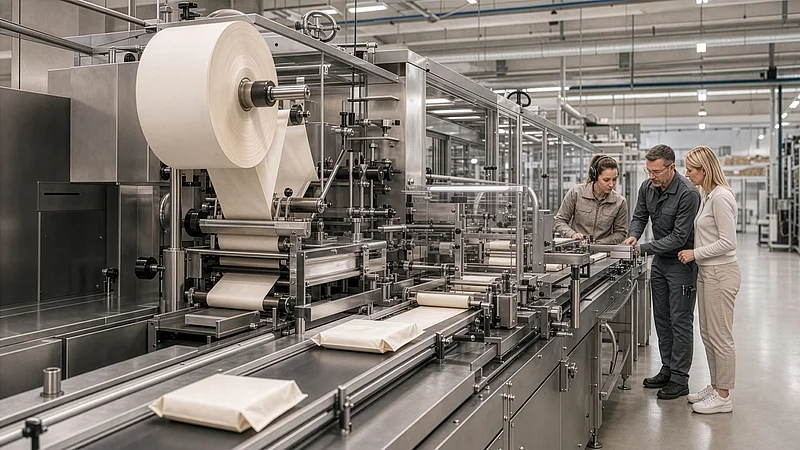
Paper-based packaging can be used on existing packaging lines. However, whether production will run reliably is not something that can be determined solely by looking at a data sheet. It is crucial that customers, machine manufacturers, partners, packaging managers, and production supervisors bring their respective perspectives together. When all stakeholders collaborate on a solution, the paper, barrier coating, machinery, product, and process control can be considered holistically from the outset and rigorously validated through machine trials.

"Will my production line run reliably if we switch from plastic to paper?" This is the question that often arises at the start of packaging projects. It is a valid concern: a packaging material might demonstrate impressive barrier or sealing properties in a laboratory setting, yet behave quite differently on a production line compared to the film previously used.

The short answer is: paper can work on existing packaging machinery—but not automatically, and not regardless of the specific application. Machine compatibility is not an inherent, isolated property of a material; rather, it emerges from the interplay between material composition, coatings, web handling, the sealing process, product requirements, and machine settings.

This alignment is best achieved through dialogue. Packaging managers and production supervisors understand the day-to-day realities of the production line, while machine manufacturers know the technical parameters and limitations of their equipment. Converters, fillers, and other partners contribute expertise in areas such as packaging design, product characteristics, and quality assurance. Felix Schoeller integrates these diverse perspectives with deep knowledge of substrates and coatings. By working together, we can identify early on what is feasible, where adjustments are required, and how a solution can be developed from initial trials through to stable, full-scale production.

At Felix Schoeller, we therefore look beyond the paper itself to consider the entire application. Our approach is: "We diagnose before we design." Co-creation across the entire value chain is not an optional extra step; it is the foundation for a solution designed to function reliably—from the production line all the way to ensuring effective product protection.

Machine compatibility is a system-wide issue

When switching to paper-based packaging, it is usually not just a single material that changes. Paper has different properties to plastic film. These include, for example, different levels of stiffness, surface texture, friction and moisture sensitivity. Coatings can specifically complement these properties, but they do not replace them with a one-size-fits-all standard solution.

Five interactions are particularly relevant to the operation of the production line:

  • Web guidance: Paper must be guided through the plant in a stable manner and with an appropriate level of tension. Friction, stiffness and surface texture influence the running of the web.
  • Forming: The packaging material must be capable of being processed into the intended geometry without barrier breaches, unwanted creases or unstable sections of the shape.
  • Sealing process: Sealing temperature, pressure, dwell time and sealing medium must be suited to the coating structure. It is not only crucial whether a material is fundamentally sealable, but also how stable the process window is on the machine.
  • Product protection: Oxygen, water vapour, grease or mineral oil components may require different barriers depending on the contents and the intended shelf life.
  • Speed and quality: A successful trial at the required speed is an important step, but does not in itself prove that stable industrial production is achievable. To do so, running behaviour, seal quality, pack quality and product protection must be assessed under realistic conditions.

This means that whilst good material properties are essential, they do not fully answer the question of machine compatibility.
 

What might change when switching from film to paper

Stiffness and web behaviour

Paper-based packaging materials are handled differently on the line compared to flexible plastic films. This means that web tension, deflections and shaping become more important. Even small differences in material composition or coating can affect creasing, register accuracy and running stability.

Sealability and process window

The seal is a key interface between the packaging material and the machine. A material must not only achieve sufficient seal strength; equally important is the width of the usable process window and how sensitive the seal is to temperature, pressure, time or contamination.

Paper-based solutions can utilise different coating structures for this purpose. Among other things, Felix Schoeller develops extrusion-coated and dispersion-coated barrier papers. Depending on the application, different priorities may be placed on barrier properties, sealability, paper content and processing behaviour. Therefore, the choice of technology is part of the application design and not a decision that can be made solely on the basis of the term ‘paper’.

Dimensional stability and product protection

The packaging must retain its function during processing and protect the product after packaging. For dry foods, snacks, confectionery or other applications, for example, moisture, oxygen and grease barriers may be of varying importance. When selecting the material, therefore, it is not simply a question of whether plastic should be replaced. The decisive factors are what level of protection the product actually requires and how this aligns with the desired paper content, recyclability and production line operation.
 

Two common assumptions fall short

Assumption 1: Paper is a direct substitute for film.

This view underestimates the interactions within the process. Even if the dimensions and basic function appear similar, web guidance, sealing behaviour and forming characteristics may change. A decision to change materials should therefore not be based solely on a comparison of technical data sheets.

Assumption 2: You always need a new packaging machine for paper.

This statement is also too general. Whether an existing line can be used depends on the material, machine configuration, packaging format, product and target speed. In many projects, the initial focus is on selecting a suitable packaging material and fine-tuning the process. Whether additional adjustments are necessary can only be reliably assessed during a specific machine trial.

The objective conclusion is: paper is not automatically a 1:1 replacement. However, it is not, in principle, only processable with a new investment. Validation under real-world conditions is crucial.
 

The sure-fire way to a reliable transition

A structured reality check reduces uncertainty before major investments or changes are made. According to Felix Schoeller, this involves four steps.

1. Jointly clarify
requirements and the current situation. First, the application, product, packaging format, existing material structure and product protection are considered. Equally important are the existing machine, relevant process steps, current settings, target speed and quality requirements. It is precisely here that the experience of packaging managers and production managers is particularly valuable. They are familiar with the day-to-day challenges of the plant and can identify at an early stage which criteria are truly crucial for stable operation.

2. Combining
material and technology selection Based on these requirements, we assess which material structure is suitable. Extrusion coating, curtain coating and dispersion coating offer different ways of imparting barrier and sealing properties to paper. The choice depends on the application, not on a general promise that works for all packaging machines.

3. Carrying
out samples and machine trials The next step involves testing the material on the intended production line. This should assess not only basic processability but also the process window, run stability, seal quality, pack appearance and relevant product protection requirements. 

A machine trial also provides guidance on which settings need to be adjusted. These may include, for example, web tension, temperature, pressure or speed. Which adjustments are appropriate depends on the specific process and should not be generalised without technical verification.

4. Ensuring
scalability Only once the results can be reproduced under realistic conditions is the solution assessed for industrial-scale production. This involves consistent material quality, defined tests, sufficient supply reliability and a shared understanding of quality criteria throughout the value chain.


Co-creation: When everyone involved works together to find a solution

Reliable paper-based packaging is rarely produced in just one place. The packaging material supplier understands the materials and coatings. The machine manufacturer understands the equipment and its technical capabilities. Packaging managers and production managers understand the ongoing process, the quality targets and the requirements for consistent production. Converters and fillers also contribute their experience in packaging design, the product and day-to-day production.

It is precisely this interplay that forms a key part of Felix Schoeller’s approach. We work closely with customers, machine manufacturers and partners throughout the entire value chain. This is not about replacing responsibilities; it is about combining the knowledge of all those involved and harnessing it to find a joint solution.

In a project, this means: production managers contribute their practical experience from the production line. Machine manufacturers can assess at an early stage which process steps or settings are particularly relevant. Converters and fillers evaluate the feasibility within the packaging process. Felix Schoeller complements these perspectives with expertise in substrates and coatings, various barrier technologies and experience in the development of fibre-based packaging materials.

This enables the creation of a solution that not only works in theory but also proves its worth as seamlessly as possible, from production right through to product protection. This shared perspective also helps to clarify requirements at an early stage, prepare trials in a more targeted manner and openly discuss possible adjustments. This builds trust and makes decisions more robust.

Felix Schoeller supports this process with an approach that ranges from the initial requirements analysis through to validation. This includes prototyping, samples, machine trials, product protection and the assessment of scalability. The advantage does not lie in promising universal compatibility. The advantage lies in jointly identifying uncertainties and developing the right solution step by step.
 

Latest developments: Sustainability must also be convincing in practice

The market for paper-based packaging is shaped by several developments. Regulatory requirements, the desire for credible recyclability and the demand for an authentic material feel are driving increased interest in fibre-based solutions. At the same time, product protection, food safety, process stability and economic scalability remain essential.

The key conclusion is this: sustainability and machine performance must not be considered in isolation. A packaging material is only a viable alternative if it meets the functional requirements and can be processed in a stable manner. Paper-based packaging is therefore not merely a question of materials; it is a systemic decision.

“The conversion of our form-fill-seal and wrapping machines to paper-based packaging materials is already a standard process. This joint validation can be planned and provides the basis for packaging development.”

Herbert Hahnenkamp, General Manager for Germany, Austria and Switzerland at SACMI Packaging & Chocolate.
 

Conclusion

There is no one-size-fits-all answer to the question of whether a machine will operate reliably when switching to paper. Paper can be used on existing packaging machines. The prerequisite is a solution that is suited to the product, pack format, coating, machine and process window.

Achieving this compatibility is a collaborative effort. When customers, machine manufacturers, partners, packaging managers and production managers pool their knowledge at an early stage, individual requirements are transformed into a clear development objective. Production experience shows what really matters in day-to-day operations. Expertise in machinery reveals the technical possibilities. Expertise in materials and coatings helps to develop a suitable packaging material from this.

A robust approach therefore begins with a joint reality check and does not end with the first successful metre produced. Only through collaboration – from requirements analysis, through prototyping and machine trials, to the evaluation of seal quality, product protection and scalability – can we determine whether an interesting material concept will become a stable packaging solution. This is precisely the essence of Felix Schoeller’s co-creation approach: all parties involved should be able to contribute their strengths so that a solution emerges which works in production today and is also viable for the next stages of development.

Are you considering switching to paper-based packaging? Start with a reality check on the application, material, machinery and process. Felix Schoeller’s packaging team can assist with selection, samples and validation through machine trials.